The Pentagon’s Mass Grave Excavation Drills
US Army Revives "Temporary Interment" Drills to Prepare for Catastrophic Casualties in Major Wars
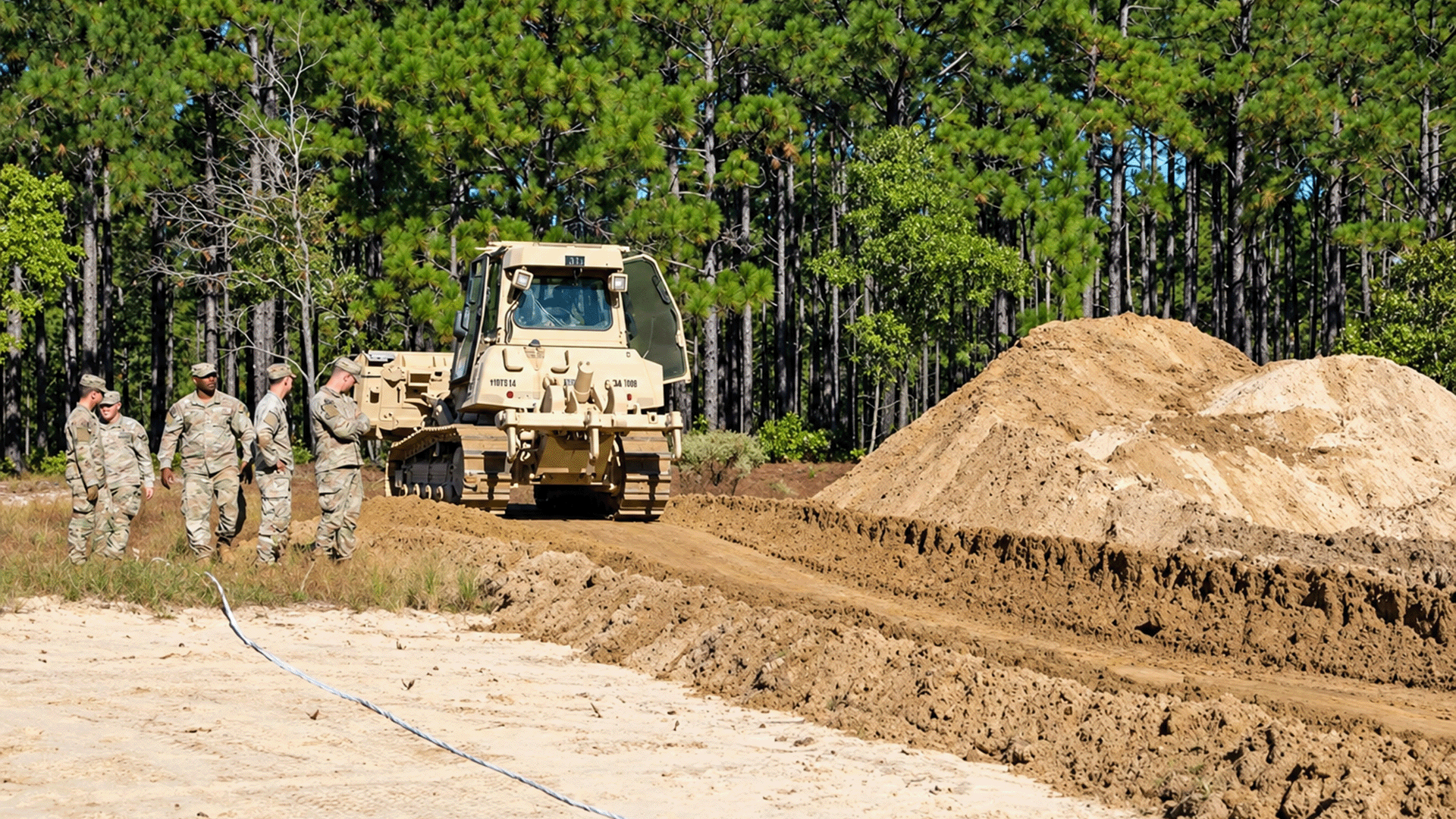
The US Army conducted field exercises at Fort Bragg (currently known as Fort Liberty) in North Carolina to simulate the excavation of temporary mass graves on battlefields. This training, which is considered the first of its kind since the Korean War, came as part of an operation named “Operation Dragon Covenant.” This coincided with reports regarding the Pentagon’s preparation for high-intensity combat scenarios, in which military bases might be forced to rely on themselves and endure for 90 days in the event of a total loss of civilian infrastructure.
Details of the Mass Grave Exercise in North Carolina:
- Exercise Purpose: To evaluate and validate procedures for large-scale battlefield temporary interments using modern heavy equipment. The drill ensures that remains are preserved intact for future forensic identification and repatriation in the event of catastrophic casualties that overwhelm conventional evacuation lines.
- Participating Units: The exercise, named “Operation Dragon Covenant,” took place near Fort Bragg (Fort Liberty), involving the 20th Engineer Brigade, 3rd Corps Sustainment Command, preventive medicine teams, mortuary affairs specialists, and military chaplains.
- Capacity and Metrics: A standard temporary interment plot consists of 5 trenches designed to hold 100 casualties. Utilizing 8 military D6 bulldozers and 4 excavators, troops proved they could systematically manage up to 2,400 casualties within a 24-hour window, averaging 1 hour and 15 minutes per trench.
Preparation for 90 Days of Infrastructure Loss:
- Total Self-Sufficiency Concept: These emergency burial drills align with reported Pentagon contingency assessments addressing the “intolerable risk” of losing civilian domestic infrastructure.
- The 90-Day Strategy: The requirement mandates that primary military installations must possess the capability to maintain operations autonomously for up to 90 days without any reliance on civilian power grids, water networks, communications, or external supply chains. This prepares forces for severe disruptions caused by large-scale cyber warfare, electromagnetic pulse (EMP) attacks, or high-intensity global conflicts.